
Unique History of Haworth in West Yorkshire
Haworth has a long and fascinating history, evolving from a small medieval settlement into one of the most famous literary villages in the world. Here’s a clear overview of its history.
Medieval Origins (1200s–1600s)
Haworth began as a small farming and church settlement on the edge of the moors.
- The village grew around St Michael and All Angels Church, Haworth, which dates back to the 13th century.
- Most people were farmers or shepherds working on the surrounding Pennine moorland.
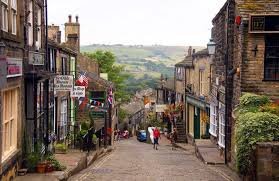
- The village layout developed around a steep track that later became Haworth’s Main Street.
Because of its remote location, Haworth remained small and isolated for centuries.
Textile and Industrial Growth (1700s–early 1800s)
During the Industrial Revolution, Haworth began to grow.
- Many families worked in wool and textile production from their homes.
- Small weaving workshops and mills appeared in the surrounding valleys.
- The population increased rapidly.
However, the village had serious sanitation problems. Houses were crowded, and water supplies were contaminated by the nearby graveyard.
By the early 1800s:
- Life expectancy was extremely low (sometimes under 25 years).
- Disease outbreaks like cholera and typhus were common.
The Brontë Era (1820s–1850s)
Haworth became world-famous because of the Brontë family.
Their father, Patrick Brontë, was the village clergyman. His children:
- Charlotte Brontë
- Emily Brontë
- Anne Brontë
grew up in the parsonage beside the church.
They wrote some of the most famous novels in English literature, inspired partly by the wild Yorkshire moors around the village.
Their home is now the Brontë Parsonage Museum, one of the most important literary museums in the UK.
Victorian Improvements and the Railway (late 1800s)
Later in the 19th century, Haworth improved significantly.
- Sanitation and water systems were modernised.
- The Keighley and Worth Valley Railway opened in 1867, connecting Haworth to nearby towns.
This railway helped:
- local industry
- trade
- tourism
Haworth Today
Today Haworth is known mainly as a historic and literary tourism village.
Thousands of visitors come every year to:
- visit the Brontë Parsonage
- walk on the surrounding moors
- explore the cobbled Main Street
- ride the historic steam railway.
Despite tourism, the village still keeps much of its Victorian character, which is why it feels like stepping back in time.
In short:
Haworth’s history moves through medieval farming → industrial textile village → Brontë literary centre → modern heritage destination.
If you seeking an Airbnb accommodation in or around Haworth, even if just for a few days, then feel free to check out Hermit Cottage